SOLACE HEALTH
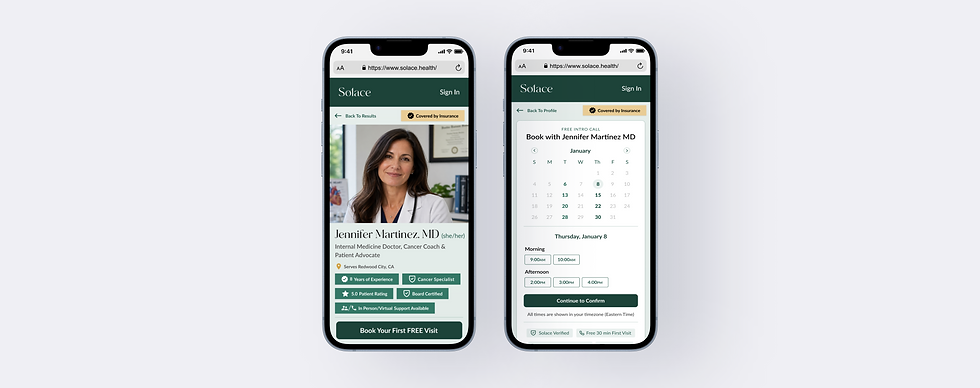
Designed a provider-matching experience that pairs individuals with dedicated care specialists to help navigate the complex U.S. healthcare system.
OVERVIEW
Product
Solace Health connects patients and families with dedicated healthcare advocates who help navigate insurance, care coordination, diagnoses, hospitalizations, and other challenges within the healthcare system.
Project
As part of a product design exercise, I redesigned the advocate profile experience and expanded the scope to include appointment scheduling. While the initial challenge focused on advocate selection, I identified a broader opportunity to support patients through the entire decision-making journey, from evaluating advocates to confidently booking care.
Role
Product Designer, solo. As a self-directed exercise, I set my own scope, from identifying the problem through final execution, owning the research audit, information architecture, scheduling flow design, and final UI across desktop and mobile, without a PM or research partner defining requirements upfront.
Scope
Desktop & Mobile Designs, Information Architecture, Product Strategy, Service Design
Timeline
1 week
THE PROBLEM
When a patient comes to Solace Health looking to pay out of pocket, they can explore advocate profiles to help narrow their selection. These profiles play an integral role in a patient's journey. Medicare patients, however, weren't offered this same visibility into advocate profiles, and were abandoning the experience at nearly twice the rate of non-Medicare patients (~40% versus ~20%).
DISCOVERY: ANALYZING THE EXISTING EXPERIENCE
An audit of the existing advocate profile experience and analysis of user behavior surfaced three specific gaps.
1. Patients had no sense of what it would actually be like to work with an advocate
Credibility highlights were visible, but not context about the relationship itself.
2. Information is difficult to scan
Key details were spread across several expandable sections, making advocates difficult to compare.
3. Scheduling feels disconnected from decision-making
Patients were asked to book an introductory call before they'd received enough information to feel confident choosing who to book with.


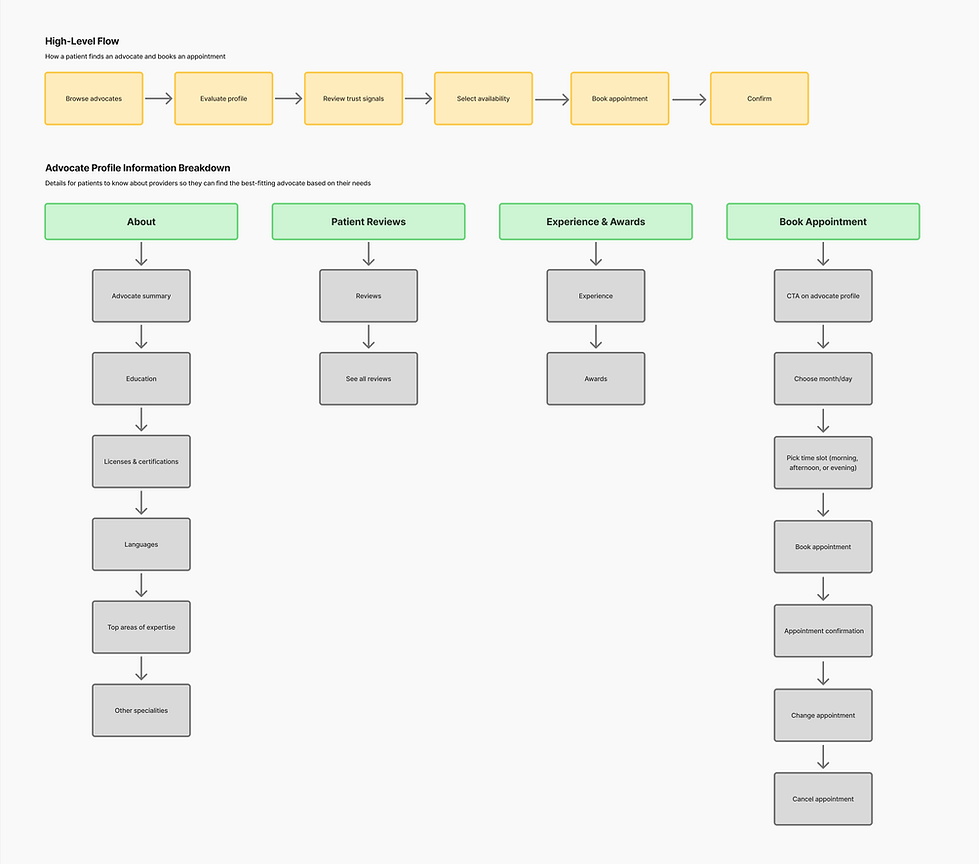
After this audit, I asked myself...
How might we help patients feel more confident when selecting and connecting with a healthcare advocate?
DESIGN PRINCIPLES
Because healthcare decisions are highly personal, patients needed greater transparency into advocate qualifications, expertise, and care approach, alongside a lower-friction path to actually booking care.
-
Build trust through transparency: Patients understand who they're meeting with before committing to care.
-
Reduce friction to care: Patients move from learning about an advocate to scheduling with minimal unnecessary steps.
-
Support confident decision-making: Patients get enough information to feel informed, without adding complexity
-
Empower patient choice: Patients control which advocate they choose, based on their own needs and preferences.
CHALLENGES
Challenge #1: How far should this project go?
The original ask was scoped to advocate profiles alone. However, the drop-off problem didn't end at profile viewing, it continued into scheduling, where patients were asked to book before they had built enough confidence to commit.
-
Stay scoped to advocate profiles only: Matches the original ask, lower risk, and faster to execute in a one-week exercise.
-
Expand scope to include appointment scheduling: Solves the full decision journey, but takes on more than what was asked, with less time to do it well.
My call: I expanded the scope to include scheduling to meet with a health advocate. Fixing the profile experience alone would have addressed what patients knew about an advocate, but it didn't go further for patients to actually commit to an appointment.
Challenge #2: Optimize scheduling for visibility, or for speed?
I explored four scheduling patterns: a full calendar view, an earliest-available shortcut, a compact date dropdown, and a horizontal date slider.
-
Earliest-available, dropdown, or slider: Each reduced the number of steps to book, optimizing for speed and lower friction.
-
Full calendar view: Showed availability across multiple weeks at once, letting patients compare options and coordinate around existing events and responsibilities, at the cost of a more visually dense screen.
My call: I chose the full calendar view. Visibility mattered more than minimizing steps, since patients weren't just booking a time and day, they were coordinating a pretty serious healthcare decision.

FINAL DESIGN FEATURES
Advocate Profile: Reimagining the Advocate Experience
Surfaced credentials, specialties, experience, and personal background information so patients could make more informed decisions while building confidence before scheduling care.
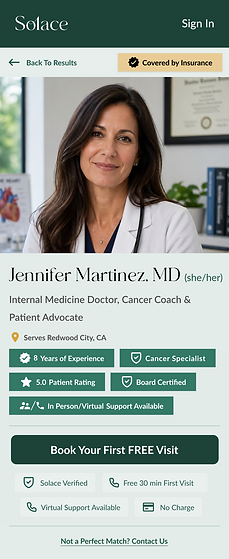


Surfaced key trust signals upfront, including expertise, credentials, ratings, and insurance coverage to help patients evaluate advocates more confidently.
Expanded advocate biographies and credentials to provide greater transparency into each advocate's background, experience, and areas of expertise.
Introduced patient reviews to provide social proof and help prospective patients make more informed care decisions.
Consolidated professional achievements, experience, and recognitions into a dedicated space for patients seeking deeper validation before booking.
Appointment Scheduling: Connecting Patients to Care
Extended the advocate profile flow to include appointment scheduling, using a full calendar view that let patients evaluate availability across multiple weeks and coordinate care around existing responsibilities.
Through exploration, I found that visibility was a more important consideration than minimizing steps. The calendar-based experience allowed patients to evaluate availability across multiple weeks, compare appointment options more effectively, and coordinate care around existing responsibilities. As a result, I selected the calendar view as the final direction.
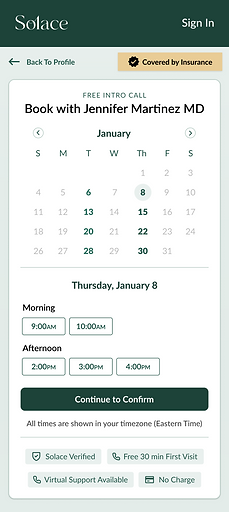
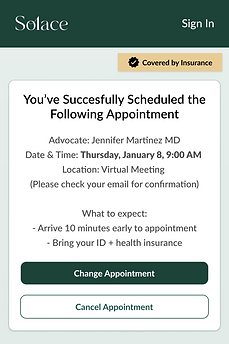
Extended the scheduling experience beyond confirmation by helping patients understand what happens next, what information to prepare, and how to get the most value from their upcoming appointment.
IMPACT & REFLECTION
Because this was a design exercise, implementation data was unavailable. To evaluate the effectiveness of the proposed solution, I established success metrics focused on patient trust, onboarding completion, and care navigation outcomes.
Advocate Profile Engagement
Percentage of patients who viewed profile details, reviews, and experience information.
Appointment Scheduling Completion Rate
Percentage of patients who successfully booked an appointment.
Medicare Patient Drop-Off Rate
Reduction in abandonment throughout the advocate selection and scheduling journey.
Time to Schedule
Average time it takes patients to move from profile exploration to appointment booking.
One of the biggest takeaways from this project was learning how trust influences healthcare decision-making. Unlike many consumer products, patients are often making decisions during moments of uncertainty or vulnerability. Designing experiences that increase transparency and confidence can meaningfully change whether a patient chooses to move forward with care at all.