SOLACE HEALTH
Pairing individuals with dedicated care specialists to help navigate the complexities of the U.S. healthcare system.
OVERVIEW
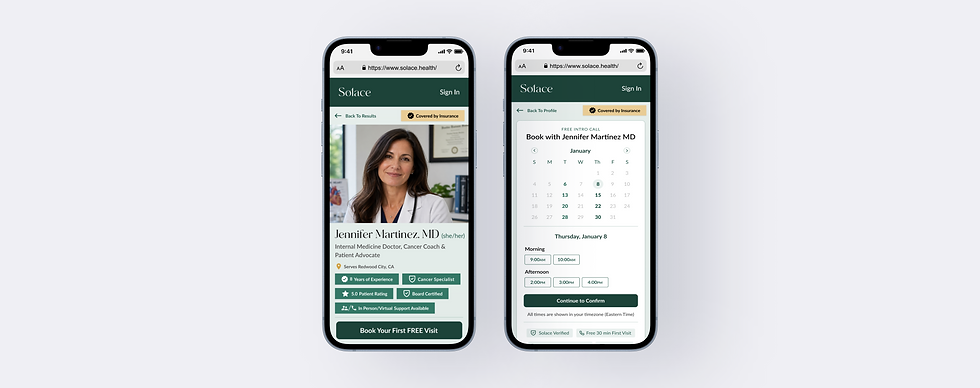
Solace Health connects patients and families with dedicated healthcare advocates who help navigate insurance, care coordination, diagnoses, hospitalizations, and other challenges within the healthcare system.
As part of a product design exercise, I redesigned the advocate profile experience and expanded the scope to include appointment scheduling. While the initial challenge focused on advocate selection, I identified a broader opportunity to support patients through the entire decision-making journey, from evaluating advocates to confidently booking care.
Role
Product Designer
Scope
Desktop & Mobile Designs, Information Architecture, Product Strategy, Service Design
Project Type
Redesign/Design Exercise
Timeline
1 week
Challenge
When a patient comes to Solace Health looking to pay out of pocket, they can explore advocate profiles to help narrow their advocate selection. These profiles showcase an advocate’s experience and play an integral role in a patient’s journey.
When a Medicare patient comes to Solace, we currently don’t offer patients the ability to see advocate profiles. Medicare patients were abandoning the experience at nearly twice the rate of non-Medicare patients (~20% versus ~40%).
Solution
Medicare patients were dropping off at a significantly higher rate than other patient groups, highlighting a lack of clarity and gap in trust in the experience. To help patients make informed and confident decisions with their health, I redesigned the advocate profile experience to surface advocate credentials, areas of expertise, and patient-facing information while introducing advocate selection prior to appointment booking.
ANALYZING THE EXISTING EXPERIENCE


1. Patients learn about the advocate, but have no understanding of what it would be like to partner with them.
While the existing profile surfaced important credibility highlights, it provided limited context around how an advocate could help a patient's unique healthcare challenges or what to expect from the relationship.
2. Information is difficult to scan.
Important information was across several expandable sections, making it difficult for patients to quickly evaluate an advocate and compare options.
3. Scheduling feels disconnected from decision-making.
Patients were asked to schedule an introductory call before receiving sufficient information about advocate fit, availability, or next steps, creating a potential gap between evaluation and action.
DISCOVERY: UNDERSTANDING THE TRUST GAP
Before exploring solutions, I wanted to better understand why patients were dropping off before scheduling care. Through an audit of the existing advocate profile experience and analysis of user behavior, I identified several opportunities to improve trust, transparency, and patient confidence. Many patients lacked sufficient information about who they would be partnering with, making it difficult to move forward with scheduling an appointment.


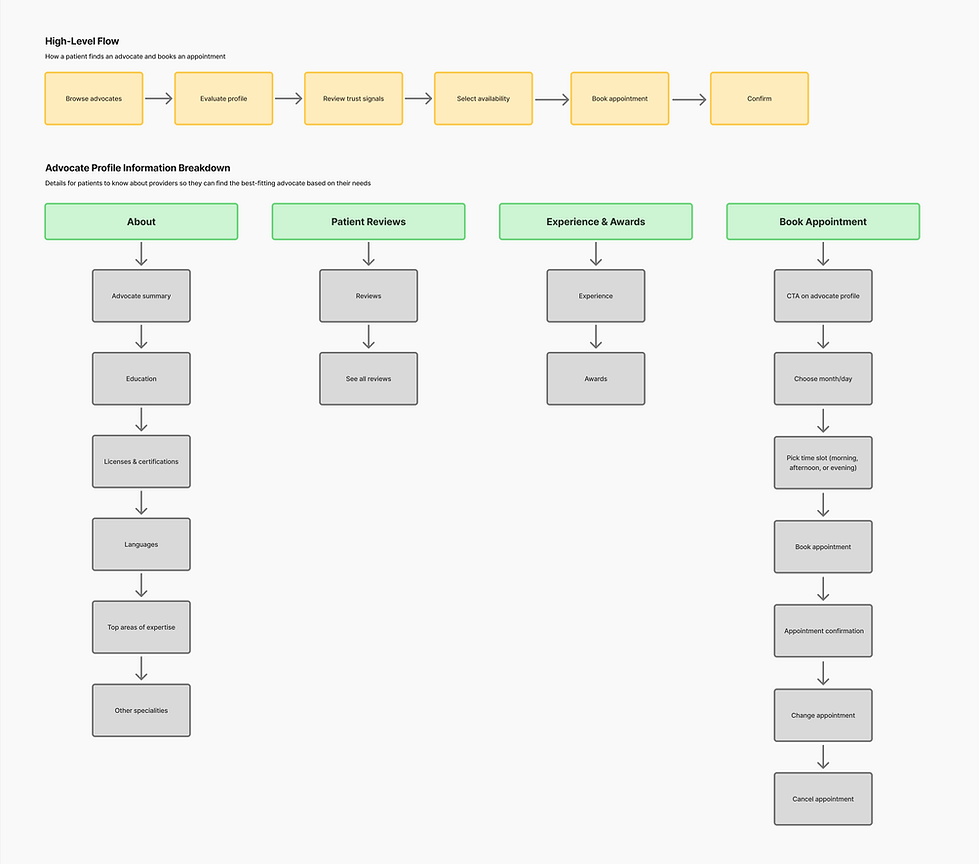
After conducting both the audit and mapping out the journey, I then asked myself...
How might we help patients feel more confident when selecting and connecting with a healthcare advocate?
DESIGN PRINCIPLES FOR BETTER CARE NAVIGATION
Because healthcare decisions are highly personal, patients needed greater transparency into advocate qualifications, expertise, and care approach. The experience also needed to reduce friction throughout scheduling while giving patients more control over selecting the advocate who best aligned with their needs.
Build trust through transparency
Patients should understand who they are meeting with before committing to care. Advocate credentials, experience, and areas of expertise should be easy to discover and evaluate.
Reduce friction to care
Patients should be able to move from learning about an advocate to scheduling an appointment with minimal effort and unnecessary steps.
Support confident decision-making
Healthcare decisions can be overwhelming. The experience should provide enough information for patients to feel informed without creating additional complexity.
Empower patient choice
Patients should have control over selecting the advocate who best aligns with their healthcare needs, preferences, and goals.
SCHEDULING EXPERIENCE EXPLORATIONS
Balancing Visibility, Flexibility & Efficiency
I explored multiple scheduling patterns to understand how patients browse availability, compare appointment options, and complete bookings.
Option 1:
Full Calendar View
A full-month calendar view provides greater visibility into provider availability, helping patients compare dates and plan appointments around their schedules.


Option 2:
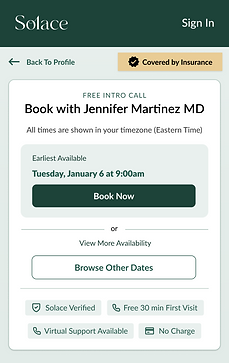
Earliest Available
Highlights the next available appointment for patients seeking immediate support, reducing the effort required to browse multiple dates and times.

Option 3:
Date Dropdown
A compact dropdown pattern reduces visual complexity while allowing patients to quickly browse and select available appointment dates.

Option 4:
Horizontal Date Slider Bar
Explored a horizontally scrollable date carousel that keeps upcoming availability visible while conserving space on mobile devices.

FINAL DESIGN FEATURES
Advocate Profile: Reimagining the Advocate Experience
By surfacing credentials, specialties, experience, and personal background information, patients could make more informed decisions while building confidence before scheduling care.
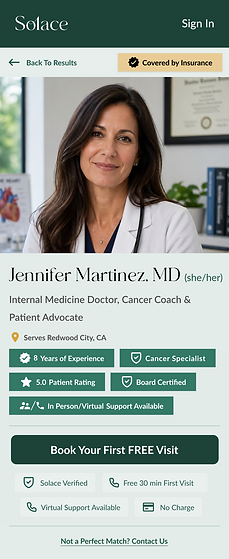


Surfaced key trust signals upfront, including expertise, credentials, ratings, and insurance coverage to help patients evaluate advocates more confidently.
Expanded advocate biographies and credentials to provide greater transparency into each advocate's background, experience, and areas of expertise.
Introduced patient reviews to provide social proof and help prospective patients make more informed care decisions.
Consolidated professional achievements, experience, and recognitions into a dedicated space for patients seeking deeper validation before booking.
Appointment Scheduling: Connecting Patients to Care
To create a more seamless experience, I expanded the advocate profile flow to include appointment scheduling. Rather than treating profile exploration and scheduling as separate experiences, the redesigned flow allowed patients to move directly from learning about an advocate to booking time with them, reducing friction and supporting continuity throughout the care journey.
Through exploration, I found that visibility was a more important consideration than minimizing steps. The calendar-based experience allowed patients to evaluate availability across multiple weeks, compare appointment options more effectively, and coordinate care around existing responsibilities. As a result, I selected the calendar view as the final direction.
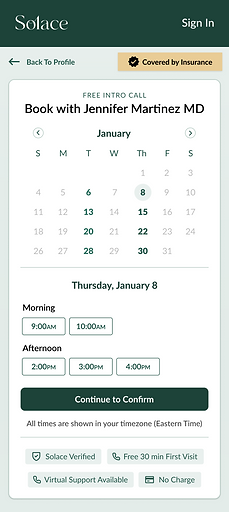
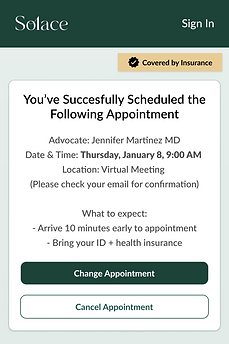
Extended the scheduling experience beyond confirmation by helping patients understand what happens next, what information to prepare, and how to get the most value from their upcoming appointment.
IMPACT & REFLECTION
Because this was a design exercise, implementation data was unavailable. To evaluate the effectiveness of the proposed solution, I established success metrics focused on patient trust, onboarding completion, and care navigation outcomes.
Advocate Profile Engagement
Percentage of patients who viewed profile details, reviews, and experience information.
Appointment Scheduling Completion Rate
Percentage of patients who successfully booked an appointment.
Medicare Patient Drop-Off Rate
Reduction in abandonment throughout the advocate selection and scheduling journey.
Time to Schedule
Average time it takes patients to move from profile exploration to appointment booking.
One of the biggest takeaways from this project was learning how trust influences healthcare decision-making. Unlike many consumer products, patients are often making decisions during moments of uncertainty or vulnerability. Designing experiences that increase transparency and confidence can have a meaningful impact on whether patients choose to move forward with care.