CUROLOGY
Extending Curology's dermatology platform, built for adults, to better serve teens and their guardians.
Increased teen onboarding completion by 50%

OVERVIEW
Product
Curology is a dermatology telehealth platform providing accessible prescription skincare for acne and other skin concerns.
Project
Extending Curology's platform, originally built for a single adult user, to support teens (13–17) and their guardians through onboarding.
Role
Product Designer: Led end-to-end design process from research through v1 and v2 launch
Team
Engineering, Providers/Clinical, Product Management, and Research
Timeline
2 months
THE PROBLEM
Curology's onboarding flow was built for one adult signing up at a time. Opening the platform to teens meant a second person, a guardian, now had to be part of a process. The current onboarding was never designed for two people with different needs, different concerns, and different comfort levels with sharing health information.
The early assumption was that we could adapt the current onboarding flow. Research showed we actually had to solve for two distinct relationships: a teen's need for ownership over their own skin routine, and a guardian's need for confidence in the treatment before they'd commit.
RESEARCH
What We Heard
In partnership with a User Research Manager, I conducted interviews with teen patients, guardians, and dermatology providers to understand their experiences, concerns, and expectations throughout the skincare treatment journey. Three recurring themes emerged and shaped the direction of the onboarding experience:
Lack of Clarity
Teens and guardians struggled to understand consent responsibilities and clinical terminology during onboarding.
High Cognitive Load
Long intake forms and dense legal
language increased
onboarding friction.
Provider Readiness Gaps
Incomplete medical information delayed treatment review
and approval.
CHALLENGES
Challenge #1: Whose experience is this?
Teens wanted ownership over their skin and skincare routine, while guardians needed confidence that treatment was worth the cost and backed by real provider oversight.
The tension: Give teens independence while keeping guardians responsible for consent and billing.
We explored separate teen and guardian accounts, but the added technical complexity didn't make sense for v1. Independent accounts also didn't reflect the guardian's responsibility for a minor's care.
The decision: Keep the guardian as the account owner, while centering the day-to-day care experience around the teen.
Designing clear moments of ownership
Rather than creating separate accounts, I designed intentional handoffs between guardian and teen within a shared experience.

Challenge #2: Where does the handoff happen?
Once we established that both guardian and teen would participate in the onboarding process, the next challenge was determining when the experience should shift from one to the other in a natural way.
We explored two different scenarios:
Guardian completes everything: Simpler for consent, but undermines the ownership teens told us mattered.
Teen takes over too early: Gives teens more independence, but asks guardians to step away before we've built enough confidence in the treatment and care model.
The decision: Start with the guardian to establish expectations, consent, and trust, then intentionally hand the clinical intake to the teen.
Additional research with teens helped us refine the sequence and validate where that transition felt most natural.

Challenge #3: Getting the clinical basics right
Two hard constraints shaped the design early on:
1. Providers required all existing skin and health history questions to stay the same: I was hoping to trim this for teens given how much friction long forms usually cause. However, incomplete and inaccurate medical information was already delaying treatment review. Shortening the questionnaire would have allowed for a faster sign up process, but a less accurate clinical provider review.
2. Providers mentioned inconsistent quality, blurry, and poorly angled photos, as an ongoing barrier to an accurate skin assessment: I wanted to fix this at launch. However, with Engineering already stretched building the shared-account structure, I made the call to prioritize the account model for v1 and delay the photo upload flow to a later time.
That tradeoff held up with our v1 launch. Providers continued to report photo issues post-launch, which gave us the data to justify the v2 investment. The redesign added visual examples for each angle, front, left, right, and other skin areas.

DESIGN SOLUTIONS
Establishing Trust & Guiding the Multi-User Journey
Teens and guardians were navigating sensitive questions together, so the experience needed to feel trustworthy, transparent, and easy to understand at every step.

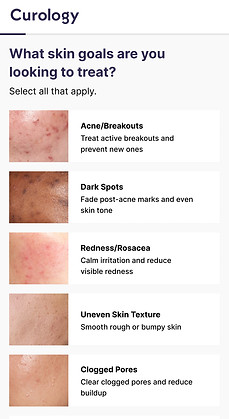


An entry point gave guardians a clearer understanding of how virtual dermatological care works.
Tooltips, like 'Not sure what your skin type is?', gave teens clarity on medical questions without leaving the flow.
Clarified guardian responsibilities around consent, account setup, and treatment approval.
Simplifying Consent & Medical Intake
Medical intake asked a lot at once to patients from health history, medications, consent, to treatment goals. I dove deep into working with Content Design to make sure we were using simple language throughout the flow.


Surfaced consent requirements earlier to improve transparency and clarify guardian responsibilities.
Simplified medical terminology to help teens answer healthcare questions with greater confidence.
Added visual guidance to help teen patients submit higher-quality photos for provider review.
Clarified provider review timelines and next steps to reduce uncertainty after onboarding.
IMPACT
The new onboarding flow improved clarity around guardian consent, medical intake, and shared account responsibilities, reducing confusion, and helping teens and guardians navigate onboarding with greater confidence and clarity.
50%
increase in teen patients completing onboarding and successfully submitting their information for provider review
20%
decrease in customer support tickets related to guardian consent and creation of new teen accounts
REFLECTION
Digital healthcare is not just about providing care virtually, but it is also understanding the intersection of systems and a digital experience that brings transparency and understanding to patients of all ages.
Prior to this project, I often thought about onboarding primarily as just a number of conversion or activation. Through this work, I gained a deeper understanding of how digital healthcare experiences can extend far beyond the screen for a patient, especially those who are going through a deep and personal struggle like acne.
This project has reinforced the importance of designing for entire systems, rather than individual touchpoints for me. It personally pushed me to think more holistically about how healthcare operations, transparency, regulatory requirements, and digital experiences intersect and are important that they mesh well together so that patients of all ages are able to receive efficient healthcare.